
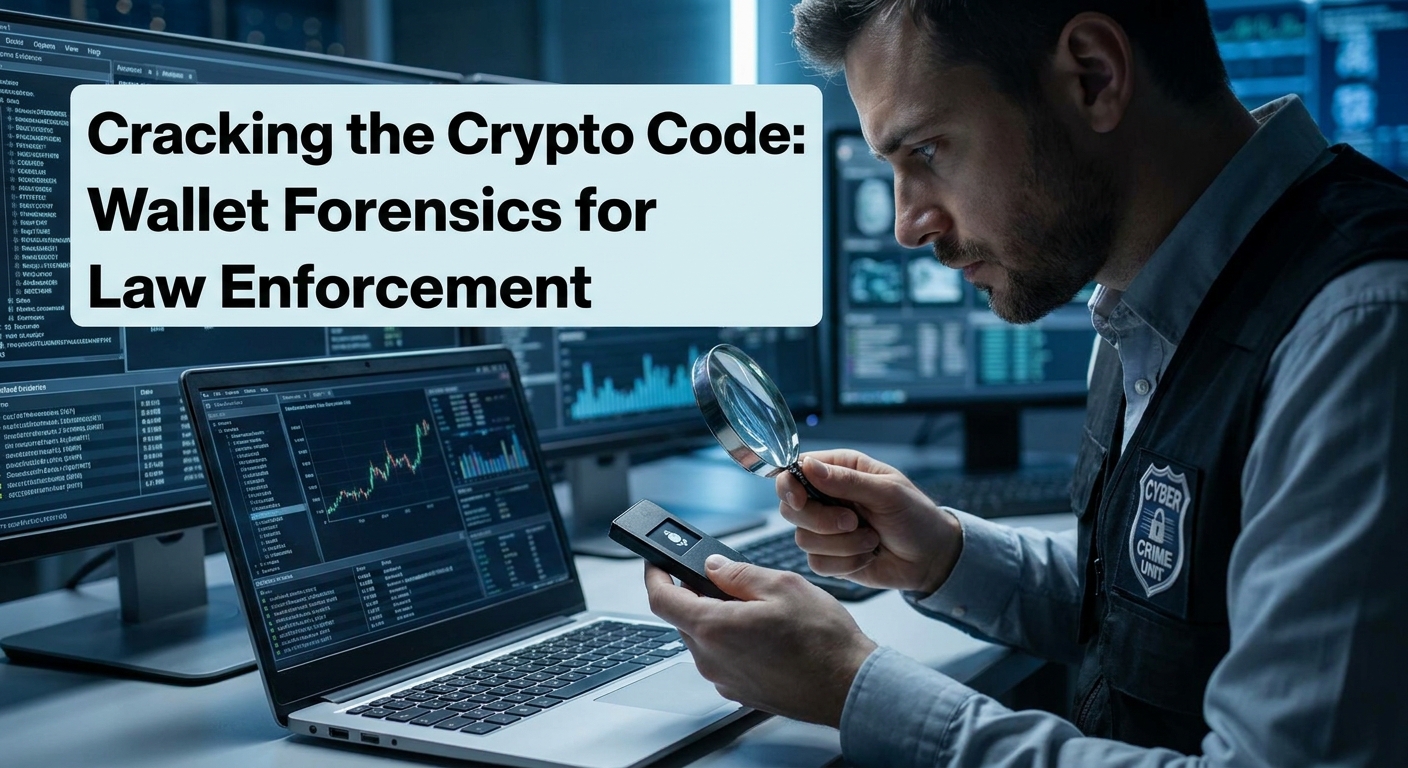
Detective Brenda Chen stared at the screen, the victim's tearful account of losing their life savings to a sophisticated cryptocurrency investment scam still echoing in her ears. The scammer, operating under the moniker "CryptoKing," had vanished, leaving behind only a trail of public blockchain addresses and a mountain of shattered trust. For Brenda, a seasoned investigator, this wasn't just another financial fraud; it was a stark reminder of how traditional investigative methods often faltered in the opaque world of digital assets. The challenge wasn't just finding the funds, but understanding how they moved, where they ended up, and ultimately, who was behind the keyboard. This is where the specialized field of wallet forensics becomes indispensable for law enforcement, transforming seemingly anonymous blockchain data into actionable intelligence.
Cracking the crypto code isn't about magic; it's about methodical, data-driven analysis and the strategic application of forensic tools. The sheer volume and complexity of blockchain data can be overwhelming, but with the right approach, patterns emerge, and digital footprints solidify into concrete evidence. Our objective is always to bridge the gap between immutable, pseudonymous blockchain transactions and the real-world identities and activities of individuals.
One of the foundational strategies in this pursuit is On-Chain Analysis and Transaction Tracing. This involves meticulously following the flow of funds from a known address (like the scammer's receiving wallet) through a labyrinth of subsequent transactions. Specialized software allows investigators to visualize these movements, identify clusters of addresses likely controlled by the same entity, and flag suspicious activities such as rapid transfers to multiple wallets, mixing services, or transfers to known high-risk exchanges. For instance, if CryptoKing’s initial wallet, 0xAbC...123, sent funds to 0xDeF...456 and 0xGhI...789, we're not just looking at those two transactions. We're examining all subsequent transactions from 0xDeF...456 and 0xGhI...789, potentially revealing a consolidation wallet or a direct deposit to a centralized exchange. Techniques like "taint analysis" help determine the percentage of illicit funds present in a given wallet, even after multiple transfers.
The next crucial step, often intertwined with on-chain analysis, is Off-Chain Data Correlation and OSINT (Open-Source Intelligence). While blockchain data is public, it's largely pseudonymous. The true power of wallet forensics emerges when we connect these digital breadcrumbs to real-world identities. This involves cross-referencing identified blockchain addresses with information gleaned from subpoenas to centralized exchanges (requesting KYC data), public social media profiles, domain registrations, or even dark web market data. Imagine tracing funds from CryptoKing's wallet to a deposit address on a major exchange. A subpoena to that exchange, armed with the specific deposit address and transaction details, could yield the name, email, and IP address used to register that account. Perhaps that email address appears in a data breach or is linked to a social media profile, providing further leads. This correlation is often the critical pivot point, transforming an anonymous address into a potential suspect.
Finally, when physical devices are seized, Digital Wallet Extraction and Recovery becomes paramount. Unlike public blockchain addresses, which are merely labels for balances, the actual "keys" to control those funds are stored in wallets – whether they are software wallets on a computer or phone, or dedicated hardware devices. Forensic investigators must employ techniques to safely extract data from these devices, which might include recovering private keys, seed phrases, or password hashes. This could involve memory forensics, file system analysis, or even chip-off data extraction for hardware wallets. For example, during a raid on a suspected money laundering operation, Agent Julian Thorne seized several laptops and a ledger device. Using specialized forensic software, he was able to identify encrypted wallet files on one laptop. Through a combination of dictionary attacks and recovered fragments of a password from the system's memory, he successfully decrypted the wallet, revealing millions in stolen cryptocurrency. This direct access to the wallet provides undeniable proof of control and ownership.
The meticulous work of tracing, identifying, and securing these digital assets forms the bedrock for eventual recovery and prosecution. It's a testament to the concept of the "Digital Chain of Custody," ensuring that every step of the data acquisition, analysis, and storage process is documented and verifiable, upholding the integrity and admissibility of digital evidence in court. Just as physical evidence must be handled with care, so too must the volatile and easily altered digital landscape be navigated with precision.
A few months later, Special Agent David Lee was reviewing a complex web of transactions related to the CryptoKing case. He had initially found a small fraction of the stolen funds routed through a lesser-known DeFi protocol, which performed a series of rapid swaps across different tokens and chains. It was a sophisticated attempt to obscure the trail. Using specialized blockchain analytics software, David was able to untangle these cross-chain transactions, following the digital thread from an obscure stablecoin pool to a wrapped token, and ultimately, to a centralized exchange. A subpoena to that exchange, based on the identified deposit address, revealed a withdrawal to a bank account registered under a name previously unknown. This intricate cross-chain analysis was the breakthrough, turning a dead end into a direct lead.
The meticulous work of tracing, identifying, and securing these digital assets forms the bedrock for eventual recovery and prosecution. When these assets are finally seized, their accurate valuation and appraisal become paramount, ensuring justice is fully served and the true extent of the financial impact is understood for all stakeholders. Understanding the forensic journey, from initial blockchain addresses to identified assets, provides critical context for anyone needing to assess the true value and provenance of seized crypto, laying a robust foundation for legal proceedings and restitution.