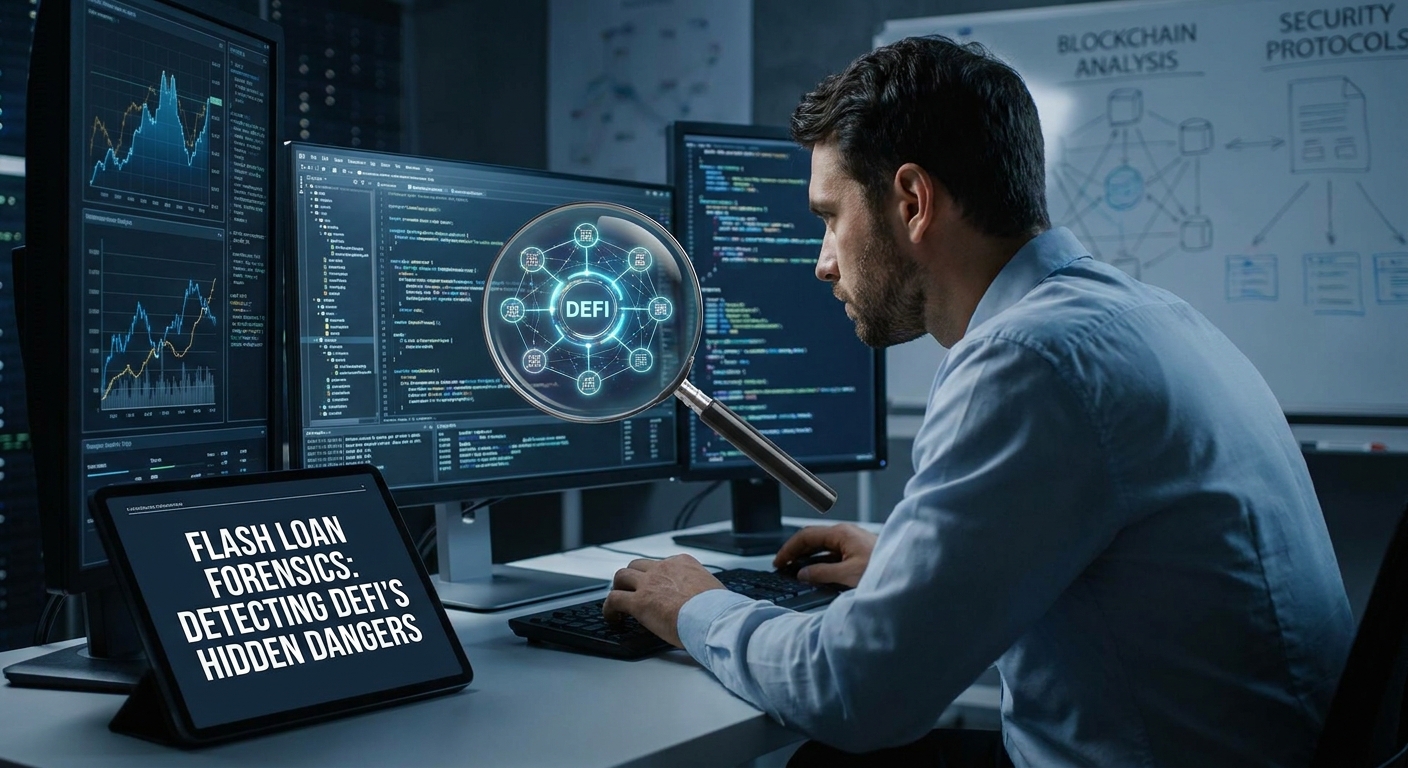
The morning David checked his DeFi portfolio, a cold dread settled in. His substantial holdings in a promising liquidity pool had vanished, replaced by a near-zero balance. There was no obvious hack, no phishing link clicked, just an inexplicable, devastating loss reflected in his wallet. A quick scan of the transaction history showed a single, complex event – a flurry of activity that unfolded and concluded within the same block, leaving his assets drained and a trail of cryptic smart contract interactions. This is the hallmark of a flash loan attack, a sophisticated exploit that leverages DeFi's unique architecture to manipulate markets and drain funds with astonishing speed and precision.
Flash loans are a marvel of decentralized finance, allowing users to borrow uncollateralized funds, often millions of dollars, provided the loan is repaid within the same blockchain transaction. This atomic property, where success depends on the entire operation completing in one go, is usually a security feature. However, malicious actors have weaponized this mechanism. By borrowing vast sums, they can temporarily manipulate asset prices across various decentralized exchanges (DEXs), exploit vulnerabilities in oracle feeds, or trigger logic errors in vulnerable smart contracts, all before repaying the initial loan and pocketing the difference. The challenge for forensic experts lies in unraveling these intricate, self-contained atomic operations, which leave a dense but often opaque data footprint.
Detecting these hidden dangers requires a methodical approach, leveraging specialized tools to dissect the complex dance of smart contract calls and fund movements. One crucial strategy is Advanced Transaction Path Analysis and Visualization. Unlike traditional financial forensics where funds move between distinct accounts over time, a flash loan attack sees assets rapidly flowing through multiple smart contracts within milliseconds. Identifying the initial flash loan source – often from protocols like Aave or dYdX – is the first step. From there, forensic analysts must meticulously trace every subsequent transfer, swap, and contract interaction. This involves digging into the call_data and event_logs associated with the transaction, effectively reconstructing the attacker's journey through the DeFi ecosystem. Visualizing this path, often as a directed graph, is invaluable; it transforms a bewildering string of hexadecimal data into an understandable flow, highlighting key pivot points where assets were swapped, prices were queried, or vulnerabilities were triggered.
Another essential strategy involves Smart Contract Decompilation and Vulnerability Review. Once the exploited smart contract is identified through transaction path analysis, the next step is to understand how it was vulnerable. Blockchain transactions only record bytecode, which is machine-readable but not human-friendly. Forensic tools can decompile this bytecode back into a more readable format, often resembling Solidity, the language in which many smart contracts are written. With the pseudo-code in hand, analysts can then perform a detailed code review, looking for common vulnerabilities such as re-entrancy issues, faulty access control, or logic errors in price calculations. The goal is to pinpoint the exact line of code or function that the flash loan attack exploited, revealing the attack vector and the specific conditions that allowed the manipulation to succeed.
Finally, Oracle Manipulation and Price Impact Analysis is frequently critical. Many flash loan attacks hinge on manipulating the price of an asset, often by executing a large, temporary trade on a low-liquidity DEX. This manipulated price is then fed to a vulnerable oracle – a decentralized data feed that smart contracts rely on for real-world information, like asset prices. Forensic analysis involves comparing the asset's price within the attacking transaction block across multiple reputable DEXs or trusted price feeds. A significant, temporary divergence from the market average is a strong indicator of oracle manipulation. Analysts must identify which oracle the exploited contract relied upon and then trace how the attacker fed it the manipulated price, often by executing a large buy or sell order on a specific, less liquid exchange within the same atomic transaction.
An overarching evidence-based concept that ties these strategies together is Attack Graph Analysis. This framework focuses on mapping the entire sequence of events, from the flash loan origination to the final profit-taking, as a series of interconnected nodes (transactions, contract calls) and edges (data flow, control flow). An attack graph provides a holistic view, illustrating dependencies and causal relationships, making it easier to identify the critical path of the exploit and understand the full scope of the compromise.
Imagine Emily, a diligent analyst, is presented with a complex flash loan attack where a lending protocol lost millions. She starts by using specialized software to visualize the transaction, immediately spotting the massive flash loan from a liquidity provider. Following the funds, she sees them flow into a DEX, then to the lending protocol, and finally back to repay the flash loan, with a significant amount diverted. Her visualization highlights a specific function call on the lending protocol that caused the loss. Emily then decompiles that contract, meticulously reviewing the code. She discovers a flaw in how the contract calculated collateral value, relying on an oracle that was easily manipulated by the attacker's temporary, large swap on a particular DEX. By cross-referencing the oracle's price feed with market data from other DEXs in that exact block, she confirms the price manipulation, effectively reconstructing the entire attack chain.
For anyone involved in DeFi, whether as an investor, developer, or insurer, understanding the anatomy of these attacks through meticulous forensic analysis is no longer optional but a critical component of risk assessment and incident response. The speed and atomic nature of flash loan exploits demand specialized tools and expertise to unravel their complexity. Proactive forensic analysis, even on seemingly secure protocols, can illuminate hidden vulnerabilities, providing an invaluable "appraisal" of potential risks before they materialize into devastating losses.