
Julian sat across from his legal team, calmly explaining that his once-substantial digital asset portfolio had been wiped out in the latest market crash. To his spouse, Elena, the story felt too convenient. Julian had been an early adopter, a man who spent his evenings discussing decentralized finance and liquidity pools. Now, in the middle of a contentious divorce, he claimed to be holding nothing but "dust" in a defunct exchange account. Elena knew the lifestyle hadn't changed; the high-end watches and the private travel continued, yet the paper trail of his wealth had seemingly evaporated into the ether.
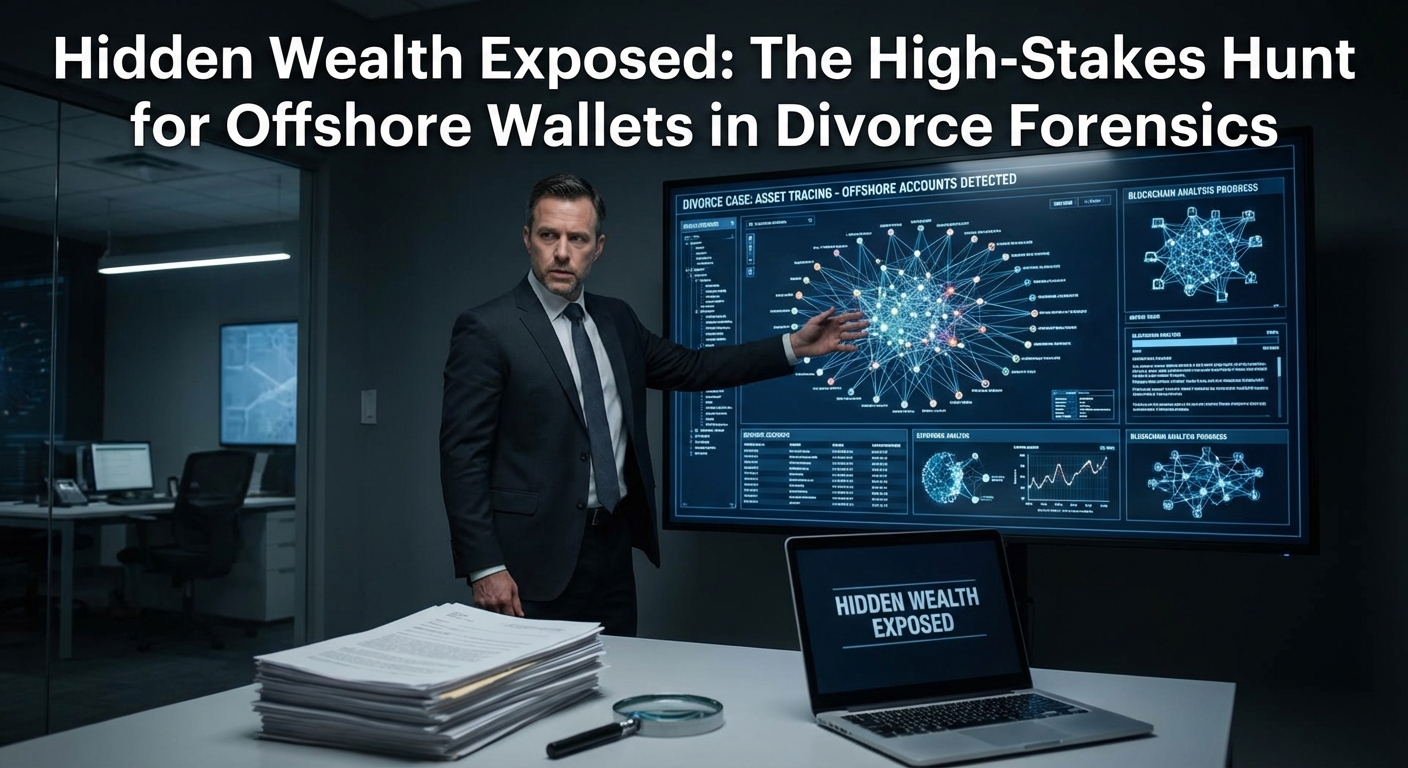
This scenario is becoming the standard in high-net-worth separations. The challenge isn't just that the assets are digital; it’s that they are often moved into "offshore" unhosted wallets—private digital vaults that exist outside the reach of traditional subpoenas. To find these assets, we have to move beyond bank statements and look directly at the heartbeat of the blockchain. When the goal is to uncover hidden wealth, the investigation relies on specialized software that can bridge the gap between a known bank transfer and a hidden private key.
One of the most effective strategies in these cases is what we call the "On-Ramp Audit." Most users, no matter how sophisticated, initially purchase their cryptocurrency through a centralized exchange like Coinbase or Kraken using fiat currency from a traditional bank. By using forensic software to analyze the withdrawal history from these exchanges, we can identify the specific "exit addresses" where the funds were sent. If a hundred thousand dollars in Bitcoin leaves an exchange and lands in a private wallet that hasn't been disclosed in discovery, that wallet becomes the focal point. We aren't just looking for the money; we are looking for the "handshake" between the regulated world and the anonymous one.
Another critical tactic involves identifying "Gas and Dust" signatures. In ecosystems like Ethereum or Solana, every action—sending a token, swapping an asset, or even voting in a DAO—requires a small amount of the native currency to pay for transaction fees, known as "gas." Often, a spouse will claim a wallet is empty or abandoned, but software analysis may reveal a series of small "gas" transfers from a known account to a hidden one. These tiny breadcrumbs prove control and activity. If Wallet A consistently funds the transaction fees for Wallet B, the legal inference of ownership is difficult to refute. It is the digital equivalent of finding a secret credit card where the monthly bill is being paid from a joint checking account.
In practice, these technical leads often collide with physical reality. Take the case of Chloe and Jasper. Jasper insisted his crypto holdings were lost when a hard drive failed years ago. However, forensic analysis of his laptop using blockchain-integrated software identified a "JSON" keystore file hidden deep within a system folder disguised as a printer driver. The software didn't just find a file; it allowed the legal team to verify that this specific file was the gateway to a wallet containing millions in obscured tokens. The "lost" hard drive was a red herring; the keys to the kingdom were synced to his cloud storage the entire time.
To understand how this works at a structural level, we rely on the UTXO (Unspent Transaction Output) model, a fundamental concept in blockchains like Bitcoin. Unlike a traditional bank account that shows a single balance, the UTXO model views wealth as a collection of "outputs" from previous transactions that haven't been spent yet. Forensic software allows us to trace the lineage of these outputs back through dozens of hops. Even if an individual uses "mixers" or "tumblers" to obfuscate the path, the immutable nature of the ledger means that every split and merge of those outputs is recorded. We aren't guessing where the money went; we are following a digital map that cannot be erased.
For those navigating a divorce where digital assets are a factor, the takeaway is clear: do not rely on self-reported exchange balances. True valuation requires a deep dive into the transaction history of unhosted wallets. If you are preparing for an appraisal, ensure your team is utilizing software capable of cross-referencing on-chain data with digital artifacts like browser history, IP logs, and hidden keystore files. The wealth isn't truly hidden; it is simply waiting for the right software to bring it back into the light. Accurate appraisals are only possible when the full scope of the digital estate is visible, and in the world of blockchain, visibility is a matter of having the right tools to look beneath the surface.