
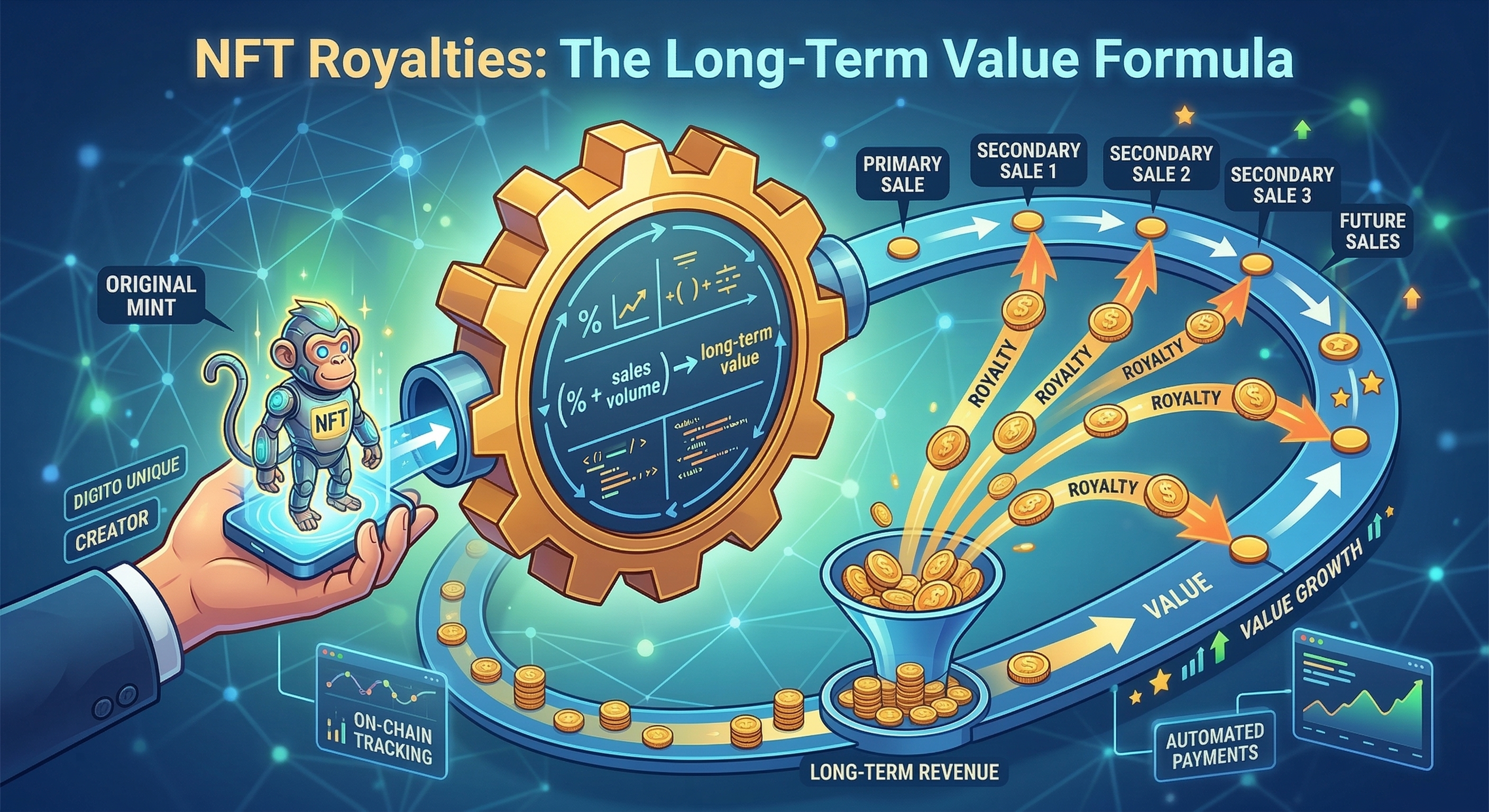
Remember when Fiona sold her 'Cosmic Dancer' NFT last year? It wasn't just the initial sale that excited her; it was the subsequent secondary market activity. When Liam bought it from Daniel six months later for a significant profit, Fiona, the original creator, automatically received a percentage of that resale. This wasn't a handshake agreement; it was a line of code, an immutable instruction embedded within the smart contract itself. This mechanism, the NFT royalty, fundamentally alters the economic landscape for digital creators and investors alike, shifting the focus from one-off transactions to a continuous value stream. For anyone navigating the complex world of digital assets, understanding how these royalties function and contribute to long-term value is paramount, especially when evaluating an NFT's true worth.
NFT royalties are essentially programmed payments, a percentage of every subsequent sale of a specific NFT on the secondary market, automatically routed to the original creator or a designated wallet. This embedded financial incentive is revolutionary because it aligns the long-term interests of the creator with the sustained success and value appreciation of their work. Unlike traditional art markets where creators rarely benefit from resales, blockchain technology ensures a continuous connection between the artist and their art's journey. This isn't merely a payout; it's a foundational element of an NFT's enduring appeal and its potential for sustained value.
To truly leverage and understand this formula, several strategic approaches come into play, each designed to maximize the impact of royalties on an NFT’s ecosystem.
One crucial strategy involves dynamic royalty structures. Instead of a static percentage, creators can implement tiered or time-based royalty models. For instance, a collection might set a 10% royalty for the first year post-mint, dropping to 5% thereafter. This encourages early trading volume while still providing a sustainable income stream. Alternatively, royalties could increase based on the number of times an NFT changes hands, subtly incentivizing community engagement and active participation within the ecosystem. The key here is thoughtful design that supports both initial momentum and long-term sustainability, often requiring careful smart contract development to ensure these complex rules are executed flawlessly.
Another powerful approach is strategic royalty allocation for ecosystem growth. Simply collecting royalties is one thing; using them to reinvest in the project's future is another entirely. A portion of the collected royalties can be directed to a community-governed Decentralized Autonomous Organization (DAO), a treasury for future development, or even a fund to commission new artists within the collection's universe. Imagine a scenario where 30% of all secondary market royalties are automatically funneled into a 'Growth Fund' that sponsors community events, grants for derivative art, or even marketing campaigns. This reinvestment cultivates a vibrant, self-sustaining community, driving continued interest and demand, which in turn fuels more secondary sales and more royalties. It's a virtuous cycle that cements long-term value.
Finally, transparency and auditability are non-negotiable. For royalties to be a credible component of long-term value, their flow must be clear and verifiable. Smart contracts need to be designed with clear payment pathways, allowing anyone to track how royalties are collected and distributed using blockchain explorers. This builds immense trust within the community and with potential investors. When a prospective buyer or appraiser can easily verify that royalties are indeed flowing to the creator or being used for stated community initiatives, it adds a layer of confidence that significantly impacts perceived value. The ability to verify these transactions on-chain is a fundamental advantage of blockchain-based assets.
This strategic use of royalties is deeply connected to the concept of Tokenomics, which describes the economic model governing a blockchain project. NFT royalties are a vital part of this model for many collections, defining how value is created, distributed, and sustained. A well-designed royalty system isn't just an afterthought; it's a core component of the tokenomics that ensures long-term viability and incentivizes all participants—creators, collectors, and community members—to contribute to the ecosystem's success.
Consider the 'Pixel Punks' collection. When their initial sales were modest, the creators, a duo named Chloe and Ben, decided to allocate 50% of all secondary market royalties to a 'Community Vault.' This vault funded exclusive events, commissioned derivative art from other artists, and even bought back undervalued Pixel Punks to maintain a healthy floor price. This strategic reinvestment created a vibrant, self-sustaining ecosystem that consistently drew new collectors, driving up both floor prices and, crucially, the volume of secondary sales. These increased sales, in turn, replenished the vault and paid out the remaining royalties to Chloe and Ben, demonstrating how judicious royalty management can transform a nascent project into a thriving digital asset.
When assessing the long-term value of an NFT or a collection, don't just look at the floor price or sales history. Dive into the smart contract. Understand the royalty structure, how those funds are allocated, and the verifiable history of those payments. A robust, transparent royalty mechanism that actively reinvests in the ecosystem is a strong indicator of sustained creator incentive and community engagement—critical factors for a defensible valuation. This forensic approach to understanding royalty mechanics is key to accurately appraising the true, enduring worth of any NFT asset.