It was a Friday evening, and the digital art market was buzzing. A young enthusiast named Javier, captivated by the vibrant community and perceived potential, had just invested a substantial portion of his savings into a new NFT collection called "Starlight Seraphs." The project boasted stunning artwork, an ambitious roadmap promising metaverse integration, and celebrity endorsements. The Discord server was electric with "LFG!" and "To the moon!" messages. Javier felt the thrill of being part of something big, a pioneer in the next wave of digital innovation. He watched the floor price steadily climb, his excitement growing with each tick. Then, abruptly, the project website went dark. The Discord server was deleted. The "celebrity" endorsements vanished from social media, revealed as paid promotions by accounts with no genuine ties. Javier’s heart sank as he realized his "Starlight Seraphs" were not a ticket to the stars, but a cruel mirage – a classic rug pull, leaving him with worthless JPEGs and a profound sense of betrayal.
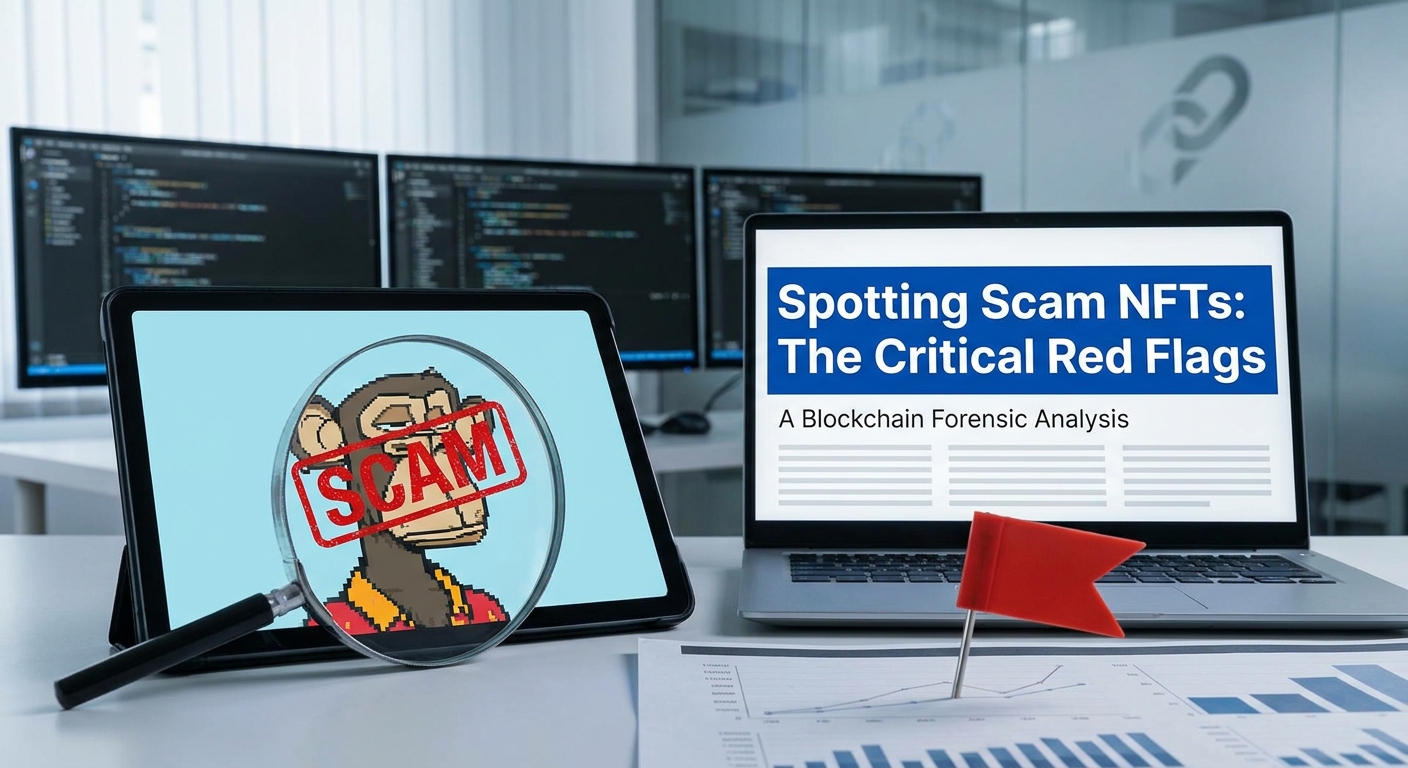
Javier's story, unfortunately, is not unique. As NFTs have exploded in popularity, so too have the sophisticated tactics of scammers looking to exploit the unwary. From counterfeit collections to elaborate rug pulls and pump-and-dump schemes, the landscape is fraught with peril. As forensic blockchain experts, our role is often to piece together these digital breadcrumbs, but prevention is always the best defense. Understanding the critical red flags can empower collectors and investors to navigate this volatile space more safely.
One of the most crucial strategies involves scrutinizing the project and its underlying team with the diligence you'd apply to any significant investment. Start by examining the project's online presence. A professional, well-maintained website with clear information, high-quality visuals, and a detailed roadmap is a baseline. Red flags emerge when websites are generic, hastily put together, or contain broken links and grammatical errors. Similarly, assess their social media footprint: is there genuine engagement, or just a flood of bot-like comments and retweets? More importantly, investigate the team behind the project. Are team members "doxxed," meaning their real identities are publicly known and verifiable? Do they have a track record of successful projects in the crypto or tech space, with LinkedIn profiles and past work that can be cross-referenced? Anonymity, while common in crypto, becomes a significant red flag when coupled with an ambitious project and no verifiable history. If the team consists solely of anonymous Discord handles and stock photos, proceed with extreme caution. For example, if a project like "Quantum Quokkas" promises revolutionary AI integration but its team comprises "CryptoNinja," "PixelPioneer," and "MetaMaestro" with no public profiles, that's a glaring warning sign.
Secondly, a deep dive into on-chain data and digital footprints can reveal a project's true intentions. The blockchain's immutable ledger is a powerful tool for transparency, and analytical software designed to access this data is indispensable. Examine the smart contract itself. Has it been audited by a reputable third-party security firm? Are there any hidden functions that allow the creators to mint unlimited NFTs post-launch, or to drain funds from the contract? Even without direct smart contract auditing expertise, you can use blockchain explorers to analyze minting patterns and transaction histories. Look for suspicious activity: a large number of NFTs minted by a single wallet or a small group of wallets, especially if these wallets were newly created. This could indicate bot activity or an attempt by the project creators to control supply and artificially inflate prices. Be wary of projects where the initial distribution seems heavily concentrated among a few addresses, which might then be used for wash trading to create false volume and interest. For instance, if you observe that 80% of a supposedly rare "Galactic Gargoyles" collection was minted by just five wallets within minutes and then immediately listed on secondary markets, that's a strong indicator of potential manipulation.
Finally, evaluating community and market dynamics provides crucial insights into a project's health and authenticity. A vibrant, organic community is a hallmark of a legitimate project. Engage with their Discord or Telegram channels. Are members asking substantive questions and receiving thoughtful answers? Or is the chat filled with generic hype, "wen moon" comments, and a lack of critical discussion? Watch out for sudden, unexplained surges in follower counts or member numbers, often indicative of bot infiltration. On the market side, analyze the trading volume and floor price. Unnatural spikes in floor price without corresponding news, developments, or genuine interest can signal a pump-and-dump scheme. Low liquidity, where only a few wallets are actively trading, can also be a red flag. Be highly skeptical of projects heavily promoted by influencers known for shilling dubious projects without genuine engagement.
An evidence-based concept that helps us understand the persistence of these scams is an adaptation of the Fraud Triangle, which posits that fraud occurs when there's Opportunity, Motivation, and Rationalization. In the NFT space, the Opportunity arises from the relative anonymity, lack of centralized regulation, and the technical complexity that can obscure malicious intent. The Motivation is almost always financial gain, often coupled with the greed of both scammers and some investors. Rationalization can manifest as "everyone else is doing it," or a belief that the rules don't apply in the nascent crypto world. Understanding these underlying drivers helps us anticipate where and why scams might appear.
In practice, a client named Maria recently approached us, excited about a new collection called "Mythic Marvels." She loved the art and the promise of exclusive access to future projects. We advised her to use analytical tools to examine the project's smart contract on the blockchain. Our analysis revealed a "backdoor" function that allowed the developers to transfer NFTs out of any holder's wallet without their permission – a critical vulnerability and a massive red flag that would have exposed Maria to significant loss. This quick, targeted check saved her from a potentially devastating scam.
For anyone needing to appraise an NFT, whether for insurance, estate planning, or investment evaluation, a deep dive into these red flags is not merely advisable – it's foundational. The perceived value of an NFT is inextricably linked to its authenticity, the integrity of its underlying project, and the security of its smart contract. Without verifying these elements through meticulous due diligence and the appropriate software tools, you're not appraising an asset; you're appraising an unchecked risk.