Julian sat at his desk, the blue light of his monitor reflecting in his eyes as he watched a Telegram group erupt with "moon" emojis. A relatively unknown token called ZenithCoin had just spiked 300% in two hours. The chat was a frenzy of FOMO, with hundreds of users claiming this was the next generational wealth opportunity. Julian, caught in the heat of the moment, swapped two Ethereum for a bag of Zenith. Within twenty minutes, the price chart pulled a vertical U-turn. The liquidity vanished, the Telegram group was deleted, and Julian was left holding tokens that were mathematically impossible to sell. He had just been the "exit liquidity" for a classic pump-and-dump.
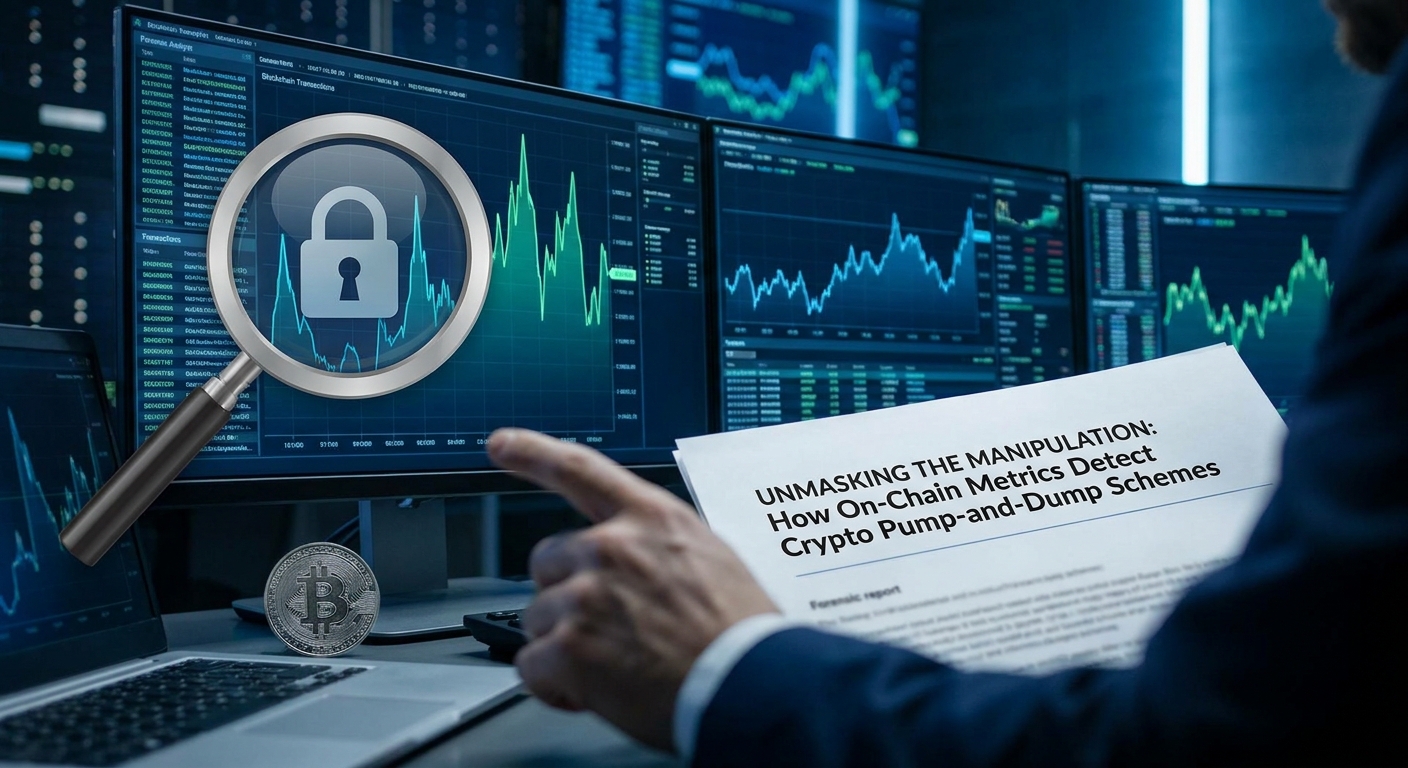
In the world of blockchain forensics, Julian’s story is a daily occurrence. However, what looks like a chaotic, unpredictable event on a price chart is actually a highly structured, visible sequence of events on the blockchain. When we use software to peer behind the curtain of the distributed ledger, the "magic" of these price spikes quickly reveals itself as calculated manipulation. Detecting these schemes requires moving past the emotional noise of social media and focusing on three core on-chain metrics.
First, we look at Wallet Clustering and Supply Concentration. In a legitimate project, token distribution tends to decentralize over time as more investors participate. In a pump-and-dump, the "insiders" usually control the vast majority of the circulating supply long before the public hears about it. Using software to perform entity resolution, we can often see that fifty seemingly independent wallets were actually funded by a single "parent" wallet just hours before the launch. If 80% of a token’s supply is sitting in ten wallets that all received their gas money from the same source, the "community" is an illusion. We call this the "Genesis Shadow." When those ten wallets all move their tokens to a decentralized exchange simultaneously, the dump is imminent.
Second, we analyze the relationship between Trading Volume and Unique Active Addresses. A healthy price increase is usually supported by a broad base of unique buyers. Manipulators, however, often use "wash trading" to create a false sense of demand. They use automated scripts to trade tokens back and forth between wallets they control, inflating the daily volume to get the token onto "Top Gainer" lists on tracking sites. If you see a token with $10 million in daily volume but only 40 unique participating wallets, you aren't looking at a market; you’re looking at a hall of mirrors. Forensic software allows us to filter out these circular trades, revealing the true, often stagnant, level of organic interest.
Third, we monitor Liquidity Pool (LP) Dynamics. In a typical rug-pull variant of the pump-and-dump, the creators provide the initial liquidity on a DEX like Uniswap. To build trust, they might claim the liquidity is "locked." However, a sophisticated analysis often reveals that the "lock" is a simple time-delay contract or, worse, a fake contract with a backdoor. By using software to trace the permissions of the LP tokens, we can see if the creators have retained the ability to withdraw the underlying ETH or USDT at a moment's notice.
These strategies are often viewed through the lens of the "Accumulation-Markup-Distribution" framework. While this is a standard economic model, pump-and-dumps compress this cycle from months into minutes. In the "Accumulation" phase, the manipulator quietly acquires or mints the supply. During "Markup," they use wash trading and social media hype to drive the price up. Finally, in "Distribution," they sell their holdings to the Julian-type investors who are buying the peak.
Consider a brief practice vignette: An analyst named Oscar was recently tasked with evaluating a sudden surge in a token called SolarFlare. While the price was skyrocketing, Oscar used his software to trace the origin of the top 20 holders. He discovered that 15 of them were created within the same ten-minute window and were all funded by a privacy mixer. He then noticed that the "Sell" function in the token’s smart contract contained a "honeypot" line of code, allowing only whitelisted addresses to divest. Because Oscar could see the code and the wallet lineage simultaneously, he could flag the project as a scam before the inevitable collapse.
For those of you tasked with appraising the value of a digital asset or investigating a sudden loss of funds, the takeaway is clear: never take a price chart at face value. A high price is not a proxy for high value if the underlying liquidity is brittle or the volume is manufactured. To truly unmask manipulation, you must verify the distribution of the supply and the behavior of the top holders. Use your software to look for "circularity" in trades and "common funding sources" for top wallets. If the on-chain data shows a small group of people talking to themselves through a smart contract, it isn’t an investment—it’s a crime scene in progress.